Category: Crypto Mining

  • ASIC Miner Value: What Really Drives Returns

    ASIC Miner Value: What Really Drives Returns

    A low purchase price can make an ASIC look like a bargain. It can also become the most expensive machine in your portfolio if it consumes too much power, loses uptime or cannot be hosted efficiently. ASIC miner value is not the number on a sales invoice. It is the machine’s ability to convert electricity, infrastructure and operating attention into reliable hashrate over its useful life.

    For a solo miner, that may mean choosing a unit that is simple to deploy and monitor. For an operator buying 150 machines or more, the calculation becomes a Capex and Opex decision with material consequences for cash flow. The right answer is rarely the highest-hashrate model or the cheapest available unit. It is the miner that fits your power rate, cooling environment, deployment schedule and risk appetite.

    What ASIC miner value really means

    An ASIC’s sticker price is only one part of its value. A more useful view combines the machine’s productive output, operating cost, expected working life and resale potential. Bitcoin mining revenue changes with the Bitcoin price, network difficulty, transaction-fee environment and block subsidy. Those variables are outside the control of any individual operator.

    What you can control is the quality of the hardware decision and the infrastructure behind it. A miner that delivers stable hashrate at a competitive watts-per-terahash figure, with dependable power and rapid technical support, has stronger practical value than a nominally cheaper unit that spends time offline.

    This distinction matters most when markets move. During strong revenue periods, inefficient machines may appear acceptable because almost every active unit is earning. When difficulty rises or Bitcoin price weakens, power-hungry equipment is usually the first to see margins compress. Efficient, well-maintained machines retain more operational flexibility.

    The four variables behind a miner’s worth

    Hashrate defines earning capacity, but not profit

    Hashrate measures how many calculations an ASIC performs each second. All else being equal, more terahash generally means a larger share of potential mining output. But comparing hashrate alone is a common procurement mistake.

    A 200 TH/s machine does not automatically offer better economics than a 150 TH/s machine. If the higher-output unit requires disproportionately more electricity, demands a more expensive cooling setup or faces longer lead times, its additional hashrate may not justify the added cost. The relevant question is how much productive hashrate you receive per pound, dollar or dirham of total deployed capital.

    For fleet operators, model consistency also has value. A standardised fleet simplifies spare-parts planning, firmware management, repair processes and performance reporting. A mixed group of older machines can be attractive at acquisition, yet create avoidable operational friction later.

    Efficiency protects the operation when margins tighten

    Power efficiency is commonly expressed in joules per terahash, or J/TH. Lower is better. It tells you how much energy a miner needs to produce each unit of hashrate.

    Electricity is often the largest recurring cost in a mining operation. A small efficiency difference becomes meaningful when multiplied across hundreds of units and thousands of operating hours. Consider two miners producing similar hashrate: the one drawing less power reduces daily electricity expense and lowers the load placed on transformers, PDUs, cabling and cooling systems.

    Efficiency is therefore not just a hardware specification. It affects the entire infrastructure design. It can influence the number of miners a site can support within its available megawatt capacity and the revenue-generating hashrate achieved from that power allocation.

    Uptime turns specifications into real output

    A miner’s advertised hashrate is theoretical until it is online, stable and submitting shares. Downtime from failed hashboards, overheating, connectivity issues or delayed repairs directly reduces output. For this reason, an uptime plan belongs in every ASIC valuation.

    Ask how the machine will be monitored, who responds to alerts, whether technicians and spare parts are available, and how quickly faults can be diagnosed. In hosted deployments, clarify whether the provider reports live hashrate, pool performance, power consumption and maintenance activity. Transparent visibility allows an investor to assess actual performance rather than relying on assumptions.

    A newer ASIC with accessible repair support can be more valuable than an older unit with attractive headline economics but no practical route to restore it when a component fails. This is particularly relevant for miners operating outside their home country or managing a portfolio remotely.

    Cooling and site fit affect long-term performance

    ASICs generate significant heat. If that heat is not managed correctly, performance can throttle, components can deteriorate faster and maintenance requirements can rise. Air-cooled miners may suit many installations, but they require sound ventilation, filtration and a site designed for high heat loads and noise.

    Hydro-cooled miners can deliver strong density and thermal control in facilities built for liquid cooling. They are not a universal upgrade. They require compatible infrastructure, water-loop design, trained operations and appropriate service arrangements. Their value is highest when the site can fully use those advantages, particularly at scale.

    Climate, dust, humidity and grid stability should also be part of the buying decision. Hardware must be matched to the actual operating environment, not simply selected from a profitability table. A sound hosting package can remove much of this complexity by combining the right electrical, cooling and security conditions with round-the-clock oversight.

    Calculating ASIC miner value before you buy

    A practical evaluation starts with the total cost to deploy, not the hardware price alone. Add the ASIC cost, freight, duties where applicable, installation, rack or container capacity, electrical infrastructure and any hosting setup charges. Then model recurring expenses: electricity, hosting, pool fees, maintenance provision and management costs.

    Next, estimate expected output using current network assumptions, while testing less favourable conditions. A base-case projection is useful, but a responsible decision also considers what happens if mining difficulty rises, the asset price falls or curtailment reduces available run time. Sensitivity analysis is not pessimism. It is how professional operators avoid treating a volatile revenue stream as fixed income.

    Payback period can be a helpful indicator, but it should not be the only measure. It may encourage buyers to favour low-cost legacy machines that have a short projected payback during a favourable market window, despite poorer efficiency and limited remaining life. Consider projected cash generation across a realistic operating horizon instead.

    Resale value deserves attention too. Latest-generation models from established manufacturers may command stronger secondary-market demand because they remain competitive for longer. However, paying a premium for the newest machine only makes sense if the efficiency improvement and expected deployment speed support the additional Capex.

    Why deployment speed changes the economics

    An ASIC that is paid for but waiting in a warehouse generates no hashrate. Delays in shipping, customs clearance, electrical commissioning or rack availability can erode the advantage of a machine purchased at an attractive price.

    This is why procurement and infrastructure should be assessed together. Before committing capital, confirm where the machines will go live, what power capacity has been allocated, whether the cooling system is ready and who is accountable for installation. A provider that manages sourcing, logistics, deployment, monitoring and repair reduces the number of handovers where delays commonly occur.

    For investors seeking managed exposure, rapid activation also improves clarity. Once miners are online, performance can be measured against the agreed hardware specification and power terms. Until then, projected returns remain just that: projections.

    Hosting costs are part of ASIC miner value

    Comparing hosting offers solely by a quoted kWh price can be misleading. The lower rate may exclude operational elements that affect actual returns, such as maintenance response, security, monitoring, curtailment terms, bandwidth, spare-part handling or transparency around power billing.

    A strong hosting arrangement should make costs understandable and responsibilities explicit. Investors need to know the contracted power rate, billing method, uptime expectations, repair process and any charges beyond electricity. For larger deployments, the structure of the power purchase arrangement and the site’s capacity for expansion can be as significant as the individual ASIC selection.

    BitHash approaches this as an infrastructure decision rather than a hardware transaction. The aim is to connect the right miner to suitable hosting, active monitoring and technical support, so the machine can operate as an asset rather than become an operational burden.

    Avoid the cheapest-machine trap

    Older ASICs often look compelling because their initial cost is low. They may still have a role where electricity is exceptionally cheap, where machines are intended for short-term use, or where an operator has established repair capability. But these conditions should be verified, not assumed.

    The risks are straightforward: lower efficiency, more frequent faults, weaker resale demand and less room to absorb adverse market conditions. A cheap miner is valuable only if its all-in operating model works. If it needs unusually low power pricing merely to remain viable, it may offer little protection when conditions change.

    The better purchase is often the one that leaves options open. Efficient hardware, dependable hosting and clear operational data allow you to continue mining, scale selectively or sell equipment from a stronger position. Treat ASIC selection as the start of an operating strategy, and every pound of deployed capital has a better chance of working harder.

  • Bitmain Versus MicroBT Miners: Which Fits?

    Bitmain Versus MicroBT Miners: Which Fits?

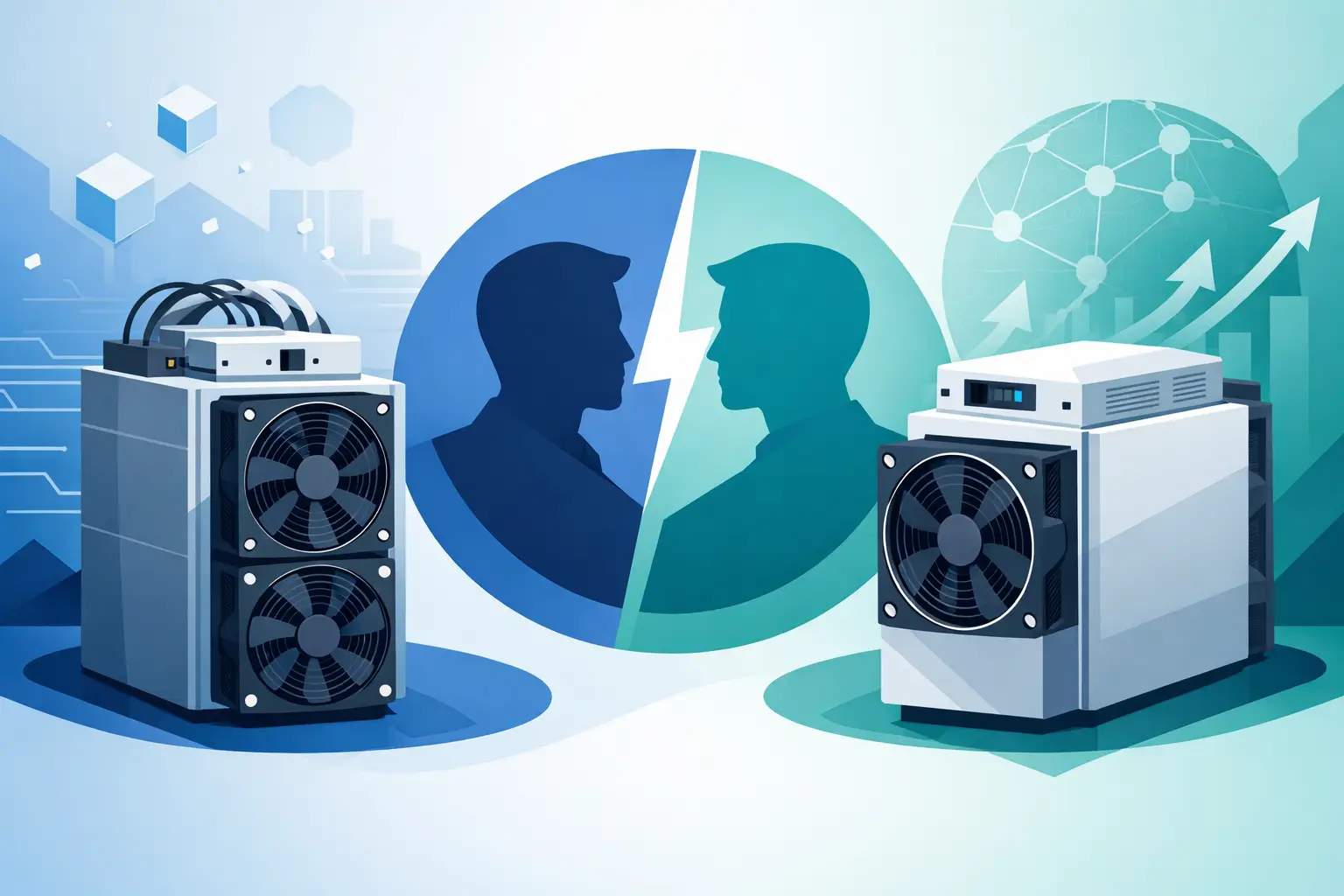
    A miner that looks stronger on a specification sheet can become the more expensive choice once it reaches a live site. A few joules per terahash, a different airflow requirement, or a slower repair route can materially change operating margin across a full fleet. That is why Bitmain versus MicroBT miners is not simply a brand preference. It is a Capex, Opex and infrastructure decision.

    Both manufacturers build high-performance SHA-256 ASICs for Bitcoin mining. Bitmain sells the Antminer range, while MicroBT produces WhatsMiner units. Both brands have proven their place in professional mining deployments, with air-cooled and liquid-cooled options across recent generations. The right decision depends on the specific model, your electricity price, the cooling design of the site and how quickly you need to scale.

    Bitmain Versus MicroBT Miners: The Core Difference

    The useful comparison is model against model, not logo against logo. Every new generation shifts hashrate, energy efficiency and operating characteristics. An older flagship may be outperformed by a newer mid-range model from the competing manufacturer, so headline brand claims are not enough.

    Bitmain’s Antminer portfolio is broad. It commonly gives operators more configuration options, including high-hashrate air-cooled units, hydro models and immersion-ready machines. That breadth can be valuable where a business runs several site types or wants to standardise on a platform as it expands.

    MicroBT’s WhatsMiner range is often selected for its straightforward industrial design and strong reputation among operators who value dependable, repeatable fleet operation. Many large-scale miners favour WhatsMiner models where the available model fits their power and cooling envelope well. The best choice is usually the machine with the lowest total cost per productive terahash at your facility, rather than the one carrying the highest headline hashrate.

    Start With Efficiency, Not Purchase Price

    ASIC efficiency is measured in joules per terahash, written as J/TH. Lower is better. A machine operating at 15 J/TH consumes less electricity per unit of hashrate than one operating at 20 J/TH. At a site with a competitive kWh price, that difference compounds every hour the machines are online.

    However, efficiency needs context. A more efficient miner often costs more to acquire. If the premium is substantial, the lower power consumption may take longer to repay it, particularly if electricity is inexpensive or the intended holding period is short. Conversely, at higher electricity prices, a modest efficiency gap can determine whether a miner remains viable when network difficulty rises.

    Use your actual electricity agreement, not a generic online profitability figure. Factor in the site’s all-in kWh rate, including any management fees, electrical losses and cooling overhead. Then model several Bitcoin price and network-difficulty scenarios. The question is not which miner earns the most today. It is which miner protects margin when conditions are less favourable.

    Hashrate matters too, especially for operators constrained by rack space, deployment labour or management capacity. A higher-hashrate unit can concentrate more output into fewer machines. Yet that same unit may draw more power and release more heat per machine, placing greater demands on breakers, cables, PDUs and ventilation. A fleet does not become simpler just because it contains fewer miners.

    Cooling Can Decide the Winner

    Air-cooled ASICs remain the most accessible route for many investors. They are generally easier to deploy, easier to inspect and compatible with a wide range of established mining facilities. Both Antminer and WhatsMiner air-cooled units can perform well, provided inlet temperatures, dust management and airflow are controlled.

    The limitation is heat. High-density air-cooled fleets require disciplined hot-aisle and cold-aisle design, reliable extraction, filtration and adequate make-up air. In warm climates, cooling infrastructure can become a material operating constraint rather than a background detail. A miner’s stated efficiency does not include every watt consumed by the wider facility.

    Hydro-cooled miners make more sense where the site is designed for them from the outset. They can support higher density, reduce airborne dust exposure and offer more controlled thermal conditions. The trade-off is clear: pumps, heat exchangers, manifolds, water treatment and leak detection must all be properly engineered and maintained. Buying a hydro ASIC without confirming compatible hosting capacity is an avoidable mistake.

    When comparing Bitmain versus MicroBT miners for a hydro deployment, verify the exact operating requirements for the selected model. Check water flow, inlet temperature range, pressure requirements, connections and expected power draw. A hydro hosting site should match the machine, rather than forcing the machine into an unsuitable loop.

    Reliability Is an Operations Question

    No ASIC manufacturer can remove the realities of continuous, high-load operation. Fans wear, hashboards fail, power supplies experience faults and environmental conditions affect component life. What separates a profitable operation from an expensive interruption is the speed and quality of the response.

    For this reason, procurement should include more than delivered hardware price. Ask about warranty terms, spare-part availability, repair capability, diagnostic processes and turnaround time. A slightly cheaper machine can lose its price advantage quickly if it sits offline while replacement parts are sourced.

    Fleet standardisation has value here. Running one primary model, or at least one primary manufacturer per site, can simplify spare holdings, technician training and monitoring rules. It also makes performance benchmarking easier. On the other hand, a mixed fleet can reduce dependence on a single supply channel and allow operators to buy the strongest economics available at the time. There is no universal answer. A 10-machine portfolio and a 1,000-machine data centre should not make procurement decisions in the same way.

    Software, Monitoring and Day-to-Day Control

    Modern mining operations need visibility beyond pool hashrate. Operators should monitor individual miner status, board temperatures, fan performance, rejected shares, power draw and downtime causes. The brand of ASIC matters less if the operation lacks a clear process for identifying and resolving underperformance.

    Before selecting Antminers or WhatsMiners, confirm that your chosen management software and hosting provider support the firmware, monitoring and alerts you require. This is particularly relevant for larger portfolios, where a small percentage of inactive machines can quietly erode revenue. Automated alerts and clear ticket ownership are practical safeguards, not administrative extras.

    For hosted customers, this is where a full-service provider adds real value. Hardware sourcing, commissioning, network configuration, 24/7 monitoring and repair coordination need to operate as one workflow. BitHash can support that path from ASIC selection through to active hosted deployment, reducing the handovers that often delay a new fleet.

    Choose by Deployment Scenario

    A first-time miner with a small number of units should prioritise an efficient, current-generation machine that the selected host already supports well. The aim is predictable operation and transparent running costs, not chasing a specification that cannot be properly cooled or serviced.

    An investor building a larger portfolio should compare delivered cost per terahash, J/TH, all-in hosting price and expected time to go live. Availability can be commercially important. A technically attractive miner that cannot be deployed for weeks may underperform a slightly less efficient alternative that starts producing promptly.

    Industrial operators should go deeper. Assess power-density limits, container or building layout, cooling topology, transformer capacity, redundancy, repair strategy and future expansion plans. At this scale, a difference in cable design or water-loop capacity can outweigh a small difference in ASIC purchase price.

    The Numbers to Confirm Before You Buy

    For each shortlisted Antminer and WhatsMiner model, obtain the current manufacturer specification sheet and confirm the delivered unit configuration. Compare nominal hashrate, power draw, J/TH, cooling type, voltage requirements, dimensions, weight, warranty and delivery timeline. Then build the investment case using site-specific electricity and hosting costs.

    Do not assume a quoted hashrate is a guaranteed financial outcome. Network difficulty, pool performance, curtailment, planned maintenance and machine availability all affect realised production. A realistic uptime assumption is more useful than an optimistic revenue projection.

    The strongest miner is the one that fits the whole operating system around it: power, cooling, monitoring, maintenance and capital plan. Select that fit carefully, and your hardware choice becomes a controlled step towards scalable Bitcoin mining rather than a costly operational gamble.

  • ASIC Miner Dubai: Buy, Host and Scale with Confidence

    ASIC Miner Dubai: Buy, Host and Scale with Confidence

    A profitable ASIC miner in Dubai is not simply a machine with an attractive hashrate figure on its specification sheet. It is a working asset that must receive stable power, appropriate cooling, continuous monitoring and fast technical attention when conditions change. Get any one of those elements wrong and a seemingly competitive miner can become an expensive, underperforming unit.

    For investors, solo miners and fleet operators, Dubai offers proximity to specialist infrastructure and a growing digital-asset ecosystem. The more useful question, however, is not merely where to buy a miner. It is how to put the right hardware into an operating environment that protects uptime, controls Opex and gives you a clear view of performance from day one.

    Choosing an ASIC miner in Dubai

    The right ASIC depends on the coin you intend to mine, the power rate available to you and the way you plan to operate. For Bitcoin mining, current-generation SHA-256 machines are generally the starting point. Their hashrate, measured in terahashes per second, matters, but efficiency matters just as much. A miner with a lower joules-per-terahash rating converts electricity into hashrate more efficiently, which can make a meaningful difference to returns over a long operating period.

    Do not buy on hashrate alone. Compare the machine’s power draw in kilowatts, stated efficiency, expected delivery timing, warranty position and availability of replacement parts. A lower purchase price can be attractive, yet an older model may consume substantially more electricity and become less competitive as network difficulty rises. Conversely, the newest machine may carry a higher Capex requirement and need a hosting environment designed for its heat output.

    Your commercial model should shape the decision. A first-time miner looking for straightforward Bitcoin exposure may prioritise a small number of efficient, hosted units and predictable monthly operating costs. An investor building a portfolio may seek a balanced fleet that can be expanded in batches. A professional operator managing 150 machines or more will need to consider rack layout, electrical distribution, firmware policy, spare inventory and the capacity to add further megawatts without relocating the fleet.

    Calculate beyond the advertised daily return

    Mining calculators are useful planning tools, but they are not promises. Bitcoin price, network difficulty, transaction-fee conditions, pool performance and machine uptime all affect realised output. The calculation should include the full operating picture: hardware cost, delivery and installation, electricity per kWh, hosting fees, pool fees, maintenance allowance and any applicable tax or administrative costs.

    It also pays to model several outcomes rather than relying on a single optimistic forecast. Test a lower Bitcoin price, a higher network difficulty and a modest reduction in uptime. If the economics only work under perfect conditions, the project is carrying more risk than the headline return suggests. Disciplined miners assess payback periods, but they also consider the residual value of hardware and their ability to redeploy or sell machines if market conditions shift.

    Why hosting is often the operational decision

    Running ASICs from a home, office or unsuitable commercial site is rarely practical at scale. High-powered miners generate intense heat, draw significant electrical load and produce sustained fan noise. More importantly, a local installation can leave the owner responsible for ventilation, fire safety, power quality, network resilience, physical security and immediate fault response.

    Managed hosting moves those responsibilities into a purpose-built environment. The provider receives the machines, installs them, connects them to your chosen pool or account, monitors their status and manages agreed maintenance processes. The objective is simple: keep your miners hashing while giving you transparency over power consumption, uptime and operating charges.

    That does not mean every hosting package is equal. The provider’s advertised rate should be understood in context. Ask whether the kWh price includes all infrastructure costs, whether there are minimum contract terms, how billing is handled, what happens when a machine is offline and whether there are separate charges for repairs, labour or shipping. Clear terms are not a minor detail. They are central to forecasting Opex and comparing one site with another.

    Cooling is a performance and longevity issue

    Dubai’s climate makes thermal management particularly relevant. Air-cooled ASICs can operate effectively in a properly engineered facility, but they require controlled airflow, filtration and capacity to remove heat consistently. A hot room, clogged filters or poor rack design can lead to throttling, higher fan wear and avoidable downtime.

    For higher-density fleets, hydro-cooling can be a compelling option. Hydro-cooled ASICs use a liquid loop to transfer heat away from the machine, allowing more controlled operating temperatures and potentially supporting denser deployments. The trade-off is that the equipment, plumbing, heat-exchange system and maintenance procedures must all be designed as one system. It is not a feature to add casually after purchasing hardware.

    The practical choice depends on fleet size, model compatibility, available facility design and the performance target. Air cooling can be the sensible route for many deployments. Hydro hosting may be better suited to operators who need higher density, more precise thermal control or a dedicated infrastructure build.

    What reliable mining operations look like

    Uptime is built through routine operational discipline rather than a single piece of equipment. Reliable sites use appropriate electrical protection, managed network connections, access controls, CCTV, environmental monitoring and clear escalation procedures. They also need people who can diagnose a fault instead of simply reporting that a machine has gone offline.

    At fleet level, miner-management software is equally valuable. A useful dashboard should show hashrate, temperature, pool connection, error status and power information at machine level. This lets an owner spot patterns early. A gradual hashrate drop across a group of units could point to network configuration, firmware settings or environmental conditions. One persistently weak miner may need a board-level inspection before the issue develops into a longer outage.

    Repair capability should be considered before a fault occurs. ASICs are specialised machines, and common issues can involve hashboards, control boards, power supplies, fans, cables or firmware. A strong maintenance process isolates the problem, confirms whether it is economical to repair and returns the unit to service quickly. For larger fleets, having a defined spare-parts and repair workflow can reduce the commercial impact of inevitable component failures.

    Questions to ask before committing

    Before purchasing hardware or signing a hosting agreement, establish who is accountable for each step. You should know the exact ASIC model and condition you are buying, where it will be deployed, when it can begin hashing and how you will access performance data. Confirm the power pricing structure, the maintenance process, security arrangements, insurance responsibilities and the procedure for withdrawing or relocating machines.

    For a dedicated data-centre project, go further. Review the proposed electrical capacity, PPA or power-supply arrangement, redundancy design, cooling architecture, construction milestones and growth plan. A turnkey facility should be designed around the fleet you expect to operate, not around assumptions that become restrictive after the first expansion.

    Speed also matters, particularly when market conditions are favourable. A provider that can source hardware, coordinate logistics, install miners and complete deployment rapidly removes a costly gap between payment and productive hashrate. BitHash approaches this as a complete operating workflow, combining ASIC sourcing with UAE-based hosting, monitoring, maintenance and infrastructure support rather than leaving customers to coordinate separate suppliers.

    Build for visibility, not just capacity

    The strongest mining setup is the one you can understand without chasing updates across several parties. Whether you own two ASICs or two thousand, you should be able to see what is running, what it is earning, what it is consuming and what action is being taken when performance falls below expectations.

    Start with hardware that suits your power economics, then choose infrastructure capable of keeping that hardware productive. Capacity can be added over time. Operational clarity, transparent pricing and accountable support should be present from the first machine you put online.

  • Are Hosted Miners Profitable? The Real Maths

    A silent ASIC in a professional facility can earn around the clock while you focus on your portfolio, rather than dealing with heat, noise, wiring and fault alerts at home. But are hosted miners profitable? The honest answer is yes, they can be – provided the machine, power contract and operating environment work together. Hosting does not create profit on its own. It protects the conditions that give a competitive ASIC its best chance to produce it.

    For an investor, hosted mining is a direct operational business. Your capital buys hashrate, then that hashrate must convert into Bitcoin at a rate that exceeds every ongoing cost. The strongest hosting arrangements make this process clearer and more controllable. The weakest hide costs, tolerate avoidable downtime and leave the owner with a machine that is technically online but commercially underperforming.

    Are hosted miners profitable after all costs?

    A hosted miner is profitable when its daily Bitcoin revenue exceeds its daily operating costs, and when the remaining cash flow can recover the purchase cost of the miner within an acceptable period. That sounds simple, yet each part of the calculation moves.

    At a basic level:

    Daily profit = daily mining revenue – electricity cost – hosting charges – pool fee – maintenance allowance

    Daily mining revenue is driven by your ASIC’s hashrate and efficiency, the Bitcoin price, network difficulty, transaction-fee conditions and the block reward. Electricity cost is driven by the miner’s power draw in kW, its operating hours and the all-in price per kWh. A useful hosting quote states exactly what is included in that all-in rate, rather than relying on a headline number that excludes facility, management or service charges.

    Consider a simplified example. A 200 TH/s ASIC consuming 3.5 kW operates at an all-in power cost of $0.06 per kWh. Its electricity cost is 3.5 × 24 × $0.06, or $5.04 per day. If the machine earns $9.00 per day before operating expenses, the gross margin is $3.96 before pool fees and any additional agreed services. If revenue falls to $6.00 as difficulty rises or Bitcoin’s price declines, that margin narrows quickly.

    This is why a profitability calculator should be treated as a scenario tool, not a promise. Run a base case, a conservative case and an upside case before buying. The question is not whether a miner looks profitable on one favourable day. It is whether it remains viable when conditions become less generous.

    Hosting changes the cost of operating, not the market

    Mining at home can appear cheaper because there is no separate hosting invoice. In reality, home mining often carries costs that are easy to miss: higher residential electricity tariffs, ventilation upgrades, electrical work, noise restrictions, internet interruptions, heat management and the time required to respond when a machine goes offline.

    A purpose-built mining facility replaces those fragmented responsibilities with a known operating structure. Industrial power arrangements, engineered airflow or hydro-cooling, physical security, network redundancy and on-site technicians are not cosmetic additions. They can materially affect uptime, hardware condition and the number of billable mining hours your ASIC achieves.

    That said, hosting is not automatically the lowest-cost answer for every miner. If you have access to reliably priced power, suitable space, electrical capacity and the technical confidence to run machines safely, self-hosting may suit you. For most portfolio investors, however, the relevant comparison is not a hosting fee versus zero cost. It is professional hosting versus the full cost and risk of doing the job properly yourself.

    The variables that decide your mining return

    Electricity pricing and contract clarity

    Electricity is usually the largest operating expense in ASIC mining. A difference of one or two cents per kWh can turn an acceptable margin into a weak one, particularly during periods of rising network difficulty. Ask whether the quoted rate includes energy, facility overhead, cooling, monitoring and applicable service charges.

    Also understand how the price can change. Is it fixed for a defined term, indexed to a tariff, linked to a power purchase agreement, or subject to a minimum consumption commitment? A low introductory rate has limited value if the terms are unclear once your machines are deployed.

    ASIC efficiency and purchase price

    The newest machine is not always the most profitable purchase, and the cheapest used machine is not always a bargain. What matters is the relationship between hashrate, energy consumption, price and expected useful operating life.

    Efficiency is commonly measured in joules per terahash. Lower J/TH means the ASIC requires less energy to produce each unit of hashrate. In a competitive market, efficient hardware tends to hold up better when revenue compresses. Older models can still work well with very low electricity pricing, but they carry a smaller margin of safety and may become uncompetitive earlier.

    Your Capex matters just as much. An expensive next-generation unit may generate stronger daily margin yet take longer to repay if bought at the peak of a hardware cycle. Compare anticipated cash flow against the delivered machine price, not only against the advertised hashrate.

    Uptime, curtailment and response time

    A miner that is offline earns nothing while its costs and capital exposure continue. Even modest uptime losses can have a meaningful effect across a fleet. A reliable host monitors performance continuously, identifies failed hashboards or network issues quickly, and has an established process for repair, replacement and redeployment.

    Ask operational questions before committing machines: how is uptime measured, what events are excluded, who authorises repairs, how are repair costs approved, and how quickly are faults escalated? Facilities may also curtail operations during exceptional power events. This can be commercially sensible, but it should be transparent in the agreement and reflected in your projections.

    Pool fees, firmware and fleet visibility

    Pool fees are relatively small, but they are part of the economics. More important is whether you can see the operational data behind your returns. You should be able to review hashrate, worker status, rejected shares, power consumption where available, payouts and downtime history.

    For multi-unit portfolios, miner-management software is more than a dashboard. It helps detect underperformance early. A machine running below its expected hashrate for several days may be losing more value than the repair cost required to return it to full output.

    How to assess a hosted-mining offer before you pay

    Do not make the decision from a calculator screenshot alone. Request a written commercial breakdown and test it against conservative revenue assumptions. The due diligence should cover the hardware, the facility and the contract as one investment case.

    Before deployment, you need clear answers on four areas:

    • the ASIC model, nominal hashrate, power draw, warranty status and delivery timeline;
    • the all-in electricity rate, billing currency, deposit requirement and any variable pricing mechanism;
    • facility security, cooling design, monitoring, maintenance process and realistic uptime reporting; and
    • ownership, access to wallet or pool configuration, withdrawal arrangements and exit or relocation terms.

    For larger fleets, ask about rack density, electrical capacity, phased deployment and the host’s ability to scale without diluting service levels. A facility that can host ten machines well is not automatically prepared to commission 150 machines on schedule.

    The UAE can be attractive for miners who value professional infrastructure, responsive regional support and a clear route from procurement to active operation. BitHash’s role in this model is to bring hardware sourcing, deployment, hosting and ongoing operational support under one accountable team, reducing the gaps where projects commonly lose time and revenue.

    Profitability is a moving target, so manage it actively

    Once the machines are live, profitability should be reviewed regularly rather than checked only when payouts arrive. Track revenue per TH, effective electricity cost, realised uptime, pool performance and each unit’s actual hashrate. Compare these figures with your original model and investigate material variance quickly.

    There will be periods when holding mined Bitcoin makes more sense than selling immediately, and periods when converting a portion of production to cover Opex is the more disciplined choice. That is an investment decision separate from whether the machine itself is operating efficiently. Keep the two decisions distinct so that a view on Bitcoin price does not mask an unprofitable operating position.

    Hosted miners are most compelling when they give you competitive power, dependable uptime and transparent control without the burden of running a data centre yourself. Start with conservative assumptions, choose infrastructure that can prove its performance, and treat every ASIC as an asset that must earn its place in your portfolio every day.

  • Bitcoin Mining Hosting UAE: What Drives Returns

    Bitcoin Mining Hosting UAE: What Drives Returns

    A miner can have the right ASIC, an attractive purchase price and a strong hashrate on paper, then lose ground through heat, downtime or unclear electricity charges. That is why bitcoin mining hosting UAE is not simply a question of where to plug in a machine. It is an infrastructure decision that directly affects uptime, operating cost and the usable life of every miner in a portfolio.

    For solo miners, hosting removes the practical burden of running loud, heat-intensive equipment at home. For professional operators, it creates a route to deploy hundreds of units without building an operations team, securing a site and managing daily faults internally. The quality of the hosting partner determines whether that convenience becomes a genuine commercial advantage.

    Why UAE mining hosting is a strategic decision

    Bitcoin mining is an always-on operation. An ASIC only earns when it is online, hashing at its expected performance and connected to a stable pool configuration. A short interruption may be manageable. Repeated interruptions, delayed repairs and poor environmental control can turn an otherwise competitive machine into an underperforming asset.

    The UAE is attractive to investors who value accessible, professionally managed infrastructure in a global digital-asset hub. However, the climate makes engineering discipline non-negotiable. High ambient temperatures put pressure on air-cooled equipment, which means a hosting site must be designed around airflow, filtration, power distribution and continuous monitoring. A low headline rate means little if machines are routinely throttling or failing under unmanaged heat.

    For larger portfolios, location also has an operational value. Investors can access a UAE-based provider, speak to a local support team and inspect a facility where appropriate, while still operating hardware without the daily workload of a self-managed site. That proximity does not replace due diligence, but it can make oversight more practical.

    What determines profitability beyond the ASIC price

    The purchase cost of an ASIC is only the opening Capex decision. Mining performance over time is shaped by Opex: electricity, hosting fees, repair costs, pool fees and the financial impact of downtime. Before committing equipment to a facility, model the economics against conservative assumptions for Bitcoin price, network difficulty and fleet availability.

    Electricity pricing deserves particular attention. Ask whether the quoted kWh rate is fixed, variable or subject to a minimum consumption commitment. Clarify whether it includes power delivery, cooling, racking, security and routine operational support. An apparently low rate that excludes essential services can be more expensive than a transparent all-in package.

    Hashprice moves constantly, while network difficulty tends to rise over longer periods. Hosting cannot remove market risk. What it can do is reduce avoidable operational losses. Consistent power, competent cooling and rapid intervention give each ASIC the best chance of producing at its expected hashrate when conditions are favourable.

    It also pays to examine the efficiency of the hardware itself. A newer machine with a lower J/TH figure can remain viable for longer when margins tighten, but it may demand more upfront capital. Older units can make sense in specific market conditions, particularly when acquired at the right price, yet their tolerance for high power costs is lower. The correct choice depends on the investor’s time horizon, risk appetite and available capital rather than hashrate alone.

    Bitcoin mining hosting UAE: the facility questions that matter

    A professional hosting provider should be able to explain how it protects availability, not merely state an uptime target. Start with power. Find out how capacity is allocated, what redundancy exists within the electrical design and how the operator handles outages or planned maintenance. For a fleet operator, understanding the difference between contracted capacity and immediately available capacity is essential.

    Cooling is equally significant. Standard air-cooled hosting can be effective when the facility has sufficient ventilation, controlled airflow and scheduled cleaning. Yet it is not the same as simply placing machines in a warehouse with extraction fans. Dust accumulation, elevated intake temperatures and poorly balanced airflow can increase fan speeds, reduce performance and accelerate component wear.

    Hydro-cooling is worth considering for high-density deployments or miners built for liquid cooling. It can provide more controlled thermal performance and reduce the operational limitations associated with air cooling in demanding climates. The trade-off is that it requires specialised infrastructure, compatible hardware and a provider able to manage pumps, water quality, heat exchange and leak prevention. It is a performance-focused choice, not an automatic upgrade for every portfolio.

    Security should be practical rather than vague. Ask about access controls, CCTV coverage, inventory records, rack labelling and the process used when a machine is moved, repaired or returned. An investor should be able to identify each unit by serial number and understand where it sits in the operational chain.

    Monitoring turns hosting into managed operations

    Hosting is most valuable when it includes active miner management rather than passive rack space. A reliable operator monitors hashrate, temperatures, fan status, rejected shares and pool connectivity. When performance drops, the team needs a defined escalation path: diagnose remotely, restart where appropriate, isolate a fault and arrange repair without leaving the customer to chase updates.

    Miner-management software gives customers visibility without requiring them to become data-centre operators. At minimum, it should make it straightforward to see whether machines are online, identify hashrate changes and review earnings-related performance. For fleet owners, grouped reporting and worker-level visibility are particularly useful because a five per cent loss across 150 machines is not a minor technical issue. It is a material commercial event.

    Communication matters just as much as dashboards. A hosting provider should set expectations on how incidents are reported, how repairs are authorised and when equipment will be brought back online. Fast deployment is valuable, but so is clear communication after deployment. BitHash approaches this as an end-to-end operational responsibility, from ASIC sourcing and installation through to monitoring, maintenance and scale-up support.

    Read the hosting agreement like an operator

    Hosting terms should make financial and technical responsibilities clear before equipment is shipped. Check the billing unit, payment schedule, contract term, deposit requirements and any minimum order quantity. For a new miner, flexibility may matter more than the lowest advertised rate. For an industrial fleet, predictable long-term capacity and clear electricity arrangements may be the stronger priority.

    Pay close attention to downtime provisions. No facility can promise that faults will never occur, but the agreement should define how outages, curtailment, maintenance windows and service interruptions are handled. It should also establish who is responsible for hardware failures, spare parts, shipping and labour. Warranty support can become complicated when miners have been sourced from another market, so confirm the repair process in advance.

    A credible provider will not present mining as guaranteed income. Returns depend on Bitcoin price, difficulty, transaction-fee conditions, the selected pool, machine efficiency and operating cost. Transparent hosting means being precise about controllable inputs while being honest about what the market decides.

    Match the hosting model to your fleet

    A first-time buyer may benefit from a plug-and-mine arrangement where hardware procurement, logistics, installation and ongoing management are coordinated by one provider. This reduces friction and avoids the common problem of buying equipment before securing capacity.

    An experienced investor with an existing ASIC portfolio may instead need migration support, serial-number tracking and a clear process for bringing machines online at a new facility. Industrial operators often require dedicated capacity planning, tailored power arrangements, engineered cooling and reporting that fits their own treasury and operations controls.

    Scale should not force a change in standards. Whether the portfolio is a small group of latest-generation ASICs or a fleet measured in hundreds of units, the fundamentals remain the same: known costs, secure equipment, visible performance and accountable technical support. The difference is that fleet size makes every weak process more expensive.

    Before sending a single miner, request a clear proposal that states capacity, power pricing, included services, expected deployment timing, monitoring access and repair procedures. Compare providers on the full operating model, not one number in a sales quote. The best hosting arrangement is the one that lets your machines spend more time hashing and less time waiting for someone to take ownership of the problem.

  • How Does Mining Hosting Work for ASIC Miners?

    How Does Mining Hosting Work for ASIC Miners?

    A new ASIC miner can be profitable on paper and still become an operational burden the moment it arrives at your premises. High power draw, heat, noise, network stability and round-the-clock maintenance quickly turn a hardware purchase into an infrastructure project. So, how does mining hosting work? You own the machines while a specialist facility provides the power, space, cooling, monitoring and technical support needed to keep them hashing.

    For solo miners, investors building a portfolio and operators managing hundreds of units, hosting replaces the practical difficulty of running equipment yourself with a defined operating arrangement. The aim is simple: get hardware online quickly, protect uptime and make operating costs visible enough to assess mining returns properly.

    How Does Mining Hosting Work?

    Mining hosting begins with the ASIC hardware. You may purchase miners directly from a hosting provider, supply machines you already own or arrange delivery from a manufacturer or reseller. Before deployment, the provider confirms compatibility, available capacity, electrical requirements and the commercial terms for your chosen site.

    Once the machines arrive, technicians inspect them, record their serial numbers and install them in racks or purpose-built containers. Each miner is connected to the facility’s electrical distribution, internet connection and cooling system. The team then configures the mining pool details and wallet settings supplied by the owner, tests hashrate and checks for errors before the equipment goes live.

    From that point, the host operates the physical environment while you retain ownership of the miners and receive the mining revenue through your chosen pool arrangement. A strong provider gives you visibility through miner-management software or regular reporting, so you can review hashrate, status, temperature, power use and downtime without being on site.

    The division of responsibility should be clear in the contract. The host normally manages facility operations, electricity procurement or billing, security, monitoring and agreed maintenance. The customer owns the machines, controls pool and wallet credentials, and pays the applicable hosting and electricity charges. Details vary, particularly for repair approvals and replacement parts, so never assume a service is included without seeing it in writing.

    What a Mining Host Actually Provides

    The value of hosting is not merely a shelf with a plug socket. ASICs operate best when the wider infrastructure is designed around their load. A modern high-performance miner can draw several kilowatts continuously. Multiply that by a fleet and the facility needs serious electrical engineering, ventilation, network capacity and operational discipline.

    Power is the first consideration. A hosting site supplies electricity through distribution systems built for sustained industrial loads, rather than domestic circuits that were never intended for a 24/7 mining operation. Your agreement may quote an all-in rate per kWh, a power price plus management fee, or another defined structure. The distinction matters because energy is normally the largest ongoing operating expense.

    Cooling is equally commercial. Air-cooled ASICs need controlled airflow to move heat away from the machines. In hotter climates, poor ventilation can lead to thermal throttling, more frequent faults and lower effective uptime. Hydro-cooling hosting uses liquid-based systems for compatible miners and can support higher-density deployments, but it requires specialised equipment and may not be the right fit for every portfolio.

    A professional facility also provides network connectivity, security and continuous monitoring. Technicians can spot an offline miner, declining hashrate, fan fault or abnormal temperature before a minor issue becomes a lengthy outage. Physical controls matter too: controlled site access, cameras, asset records and documented handling procedures reduce the risk associated with valuable equipment operating far from its owner.

    From Payment to Live Hashrate

    Deployment speed depends on whether the facility has available capacity, the machine model is in stock and the commercial checks are complete. Where capacity and hardware are ready, a well-organised host can deploy within 24 hours of payment confirmation. For larger fleets, the process may include staged delivery, electrical planning and commissioning milestones.

    The practical sequence is straightforward. You select the ASIC model and hosting package, confirm the hardware quantity and site, and agree the electricity rate, term, fees and service scope. The provider receives the miners, performs intake checks, installs them and connects them to the selected mining pool. After testing, you should receive confirmation that the units are online, together with access to monitoring data.

    For an investor, the most useful question is not simply, “When will my miners start?” It is, “What evidence will show they are operating as expected?” Ask how the provider reports online status, accepted hashrate, rejected shares, power consumption and maintenance events. Pool-side hashrate and facility-side monitoring can differ slightly over short periods, but persistent gaps deserve an explanation.

    Costs That Determine Whether Hosting Makes Sense

    Mining hosting simplifies operations, but it does not remove mining economics. Your result still depends on Bitcoin price, network difficulty, block rewards, transaction fees, miner efficiency, pool fees and electricity costs. Hosting makes these inputs easier to manage, not guaranteed.

    The cost structure usually includes the ASIC purchase price or Capex, electricity consumption, a hosting or management charge, shipping and possible import costs, pool fees, and repair or replacement-part costs. Some providers combine several of these into a single kWh rate; others itemise them. Neither approach is automatically better. Transparency is what lets you compare offers accurately.

    Review the rate alongside the machine’s efficiency, usually expressed in joules per terahash. A more efficient ASIC may cost more upfront but consume less power for the same hashrate. Conversely, a lower-priced older unit can look attractive until electricity and repair requirements are modelled over several months.

    It is also worth checking minimum commitments and payment terms. Industrial hosting agreements may require a minimum number of machines, a fixed contract duration or advance electricity deposits. These terms can support stable infrastructure planning, but they affect your flexibility if market conditions change.

    Uptime, Maintenance and the Reality of Operations

    No hosting facility can honestly promise that every machine will run without interruption. Grid events, pool connectivity issues, firmware faults, failed fans, power supply problems and hashboard errors can occur. What separates a reliable hosting operation is the speed and quality of its response.

    Ask how downtime is detected, who performs first-line diagnostics and whether rebooting, cleaning and basic fault checks are included. For more serious issues, confirm the repair process: whether approval is required, how labour is priced, whether spare parts are held locally and how long a typical repair takes. A low hosting rate loses its appeal if machines wait weeks for a simple replacement component.

    For sizeable fleets, reporting should support operational decisions rather than merely reassure. You should be able to identify underperforming units, compare actual hashrate with expected output and understand whether losses come from the machine, the pool or the facility. This is where hands-on technical support and clear software access become part of the return profile.

    Choosing the Right Hosting Arrangement

    The right provider depends on your scale and priorities. A first-time miner may value an all-in package, guided pool setup and direct support. A professional operator may focus on contracted power capacity, PPA structure, hydro-cooling capability, fleet-level reporting and room to scale beyond 150 units.

    Before committing, examine the facility’s location only in relation to what it changes: electricity economics, climate, regulatory environment, logistics and access to technical staff. UAE-based hosting can be particularly valuable for investors who want regional support, structured deployment and a clear point of accountability, while global options may suit portfolios seeking different power markets.

    BitHash approaches hosting as part of the full mining workflow, from ASIC sourcing and deployment to 24/7 monitoring, maintenance and expansion planning. That single-provider model can reduce handovers between hardware sellers, freight agents, data-centre operators and repair teams.

    The best hosting arrangement is one you can audit before and after your miners go live. Understand the price per kWh, know exactly what support covers, keep control of your pool and wallet settings, and monitor performance against realistic assumptions. When those foundations are in place, hosting lets your mining hardware work where the infrastructure is built to keep it working.

  • Mining Farm Security Features That Protect Uptime

    Mining Farm Security Features That Protect Uptime

    A mining farm can lose money long before a machine actually fails. One unauthorised visitor, an overheating rack, a compromised management account or a poorly handled power event can take hashrate offline and create an expensive recovery job. The right mining farm security features protect more than ASICs. They protect uptime, operational control and the predictability of your mining returns.

    For a solo miner, security may begin with knowing where each unit is installed and who can touch it. For an industrial fleet, it becomes a layered operating system covering the site perimeter, access permissions, surveillance, network design, power infrastructure and incident response. The objective is the same at every scale: keep authorised machines hashing, keep risks contained and make every event traceable.

    Mining Farm Security Features Start at the Perimeter

    ASIC miners are compact, high-value assets. A rack of current-generation units can represent significant Capex, which makes physical security a commercial requirement rather than a box-ticking exercise. A professional facility should control access from the outer boundary through to the individual mining hall.

    The first layer is a secured perimeter with defined entry and exit points. Fencing, controlled gates, adequate lighting and monitored external areas make opportunistic access far harder. Cameras should cover approach routes, loading areas, entrances, corridors and mining halls without leaving obvious blind spots. Coverage only matters if footage is recorded reliably, retained for an appropriate period and available when an incident needs to be reviewed.

    Inside the site, access should narrow as equipment value and operational sensitivity increase. Reception areas, storage rooms, electrical rooms, network cabinets and mining halls should not all have the same access rules. Badge access, biometric verification or managed key systems provide a clear record of who entered a restricted area and when. This is particularly valuable when contractors, delivery teams and maintenance engineers attend the site.

    Visitor management also deserves attention. A signed-in visitor with an escort is very different from an untracked person walking through an operational facility. Clear procedures reduce both theft risk and accidental disruption, such as a visitor disconnecting a cable or entering a hot aisle without suitable protection.

    Protect the Machines From the Risks Inside the Facility

    Security is not limited to intrusion. In mining, heat, dust, humidity, water and electrical faults can be just as damaging as physical theft. The strongest facilities treat environmental control as part of asset protection.

    Temperature and airflow monitoring should operate continuously, not only when technicians are on site. ASICs can tolerate demanding conditions within their manufacturer specifications, but sustained heat stress affects stability, fan performance and component life. Sensors around racks, intake zones and exhaust paths help operators identify a developing thermal issue before miners begin to throttle or go offline.

    Dust filtration and disciplined housekeeping matter in air-cooled environments. Fine dust restricts airflow, collects on heat sinks and increases the maintenance burden. At scale, poor cleaning standards can become a fleet-wide efficiency and reliability problem. A planned inspection schedule is more effective than waiting for fault alerts to appear.

    For hydro-cooled mining, the risk profile changes rather than disappears. Leak detection, pressure monitoring, water-quality management and isolated pipework zones become central controls. A small leak can escalate quickly around high-density electrical equipment, so the facility needs immediate alarms, clear shut-off procedures and trained personnel who understand the cooling loop.

    Fire detection and suppression must be designed around the actual site, electrical load and equipment layout. Early detection is critical. Thermal monitoring, smoke detection, protected cable routes and properly maintained suppression equipment all contribute to a faster response. The right approach depends on the building, local requirements and whether the operation is air-cooled or hydro-cooled, but a generic office-grade set-up is not enough for a high-load mining environment.

    Power Security Is Uptime Security

    A low electricity price means little if power quality repeatedly puts miners offline. Mining farms need a power design that protects equipment from unstable supply while allowing faults to be isolated quickly.

    This begins with correctly specified switchgear, distribution boards, breakers and cabling. Each element must be sized for continuous mining loads, not simply short bursts of demand. Load balancing across phases is equally important. An overloaded circuit or poorly balanced distribution arrangement creates heat, trips and avoidable downtime.

    Surge protection and grounding help defend sensitive electronics against voltage events. Monitoring systems should provide visibility into voltage, current, frequency and load behaviour so operators can identify anomalies before they become failures. Where a site uses backup generation, energy storage or multiple supply paths, the transfer process must be tested under real operating conditions.

    Redundancy needs a commercial lens. Not every miner requires a fully redundant electrical path, and building one can raise hosting costs materially. The practical question is whether the expected reduction in downtime justifies the additional Opex and infrastructure investment. For a large fleet or dedicated data centre, redundancy may be essential. For a smaller portfolio, strong monitoring, quality components and rapid technical response may deliver better value.

    Network and Account Controls Prevent Remote Losses

    Modern ASIC operations are managed through networked tools, firmware, pool credentials and miner-management software. That convenience creates another attack surface. If an unauthorised party gains control of a fleet, they may change pool settings, divert hashrate, alter firmware or disrupt operations without ever entering the building.

    A secure mining network separates operational technology from guest networks and ordinary office traffic. Miners, management servers, camera systems and administrative devices should not all sit on one unrestricted network. Segmentation contains potential problems and makes suspicious activity easier to investigate.

    Management interfaces should use unique, strong credentials, multi-factor authentication where available and tightly controlled user permissions. A technician who needs to view machine status does not necessarily need authority to change wallet addresses, update fleet firmware or modify network settings. Role-based access limits the impact of an accidental change or compromised account.

    Firmware management is another critical control. Only verified firmware from trusted sources should be deployed, with updates tested on a controlled group before a full fleet rollout. The latest release is not automatically the best release for every operation. A staged deployment protects against compatibility issues, unexpected performance changes and configuration errors that could affect hundreds of units at once.

    Logging closes the loop. Good records show configuration changes, login attempts, machine reboots, pool updates and alert history. When hashrate moves unexpectedly, operators should be able to determine whether the cause was a network issue, a power event, a planned change or something that requires escalation.

    Monitoring Must Lead to Action

    Twenty-four-hour monitoring is only useful when alerts reach someone who can act. A dashboard full of red indicators does not protect revenue if no one has ownership of the response.

    Effective monitoring combines machine-level data with site-level conditions. Hashrate, rejected shares, chip temperatures, fan speeds, error codes and pool connectivity tell one part of the story. Power quality, cooling performance, access events, camera status and network health tell the rest. Correlating these signals helps teams diagnose the root cause faster.

    A practical incident plan defines thresholds and responsibilities. If a single miner drops offline, the response may be a scheduled technician check. If an entire row loses hashrate, the team may need to inspect network switches, distribution equipment or cooling immediately. If a management account records an unfamiliar login, credentials and permissions may need to be disabled before any hardware intervention begins.

    Clients should also receive meaningful visibility. Clear reporting on uptime, machine status, maintenance activity and electricity consumption turns security from an unseen promise into an operational standard. This transparency matters most during a fault, when investors need facts rather than vague reassurance.

    Choose Security That Matches Your Mining Model

    The right level of protection depends on fleet size, hardware value, site geography, cooling method and the degree of operational control you want to retain. A home set-up may prioritise discreet storage, fire safety and secure remote access. A hosted fleet should prioritise the provider’s access controls, surveillance, network practices, maintenance capability and reporting discipline. A purpose-built data centre needs all of these controls integrated from the design stage.

    Ask direct questions before placing hardware. Who can access the machines? Is entry logged? How is the site monitored after hours? What happens when an ASIC goes offline? How are firmware changes approved? Is there a documented process for power, cooling, fire and network incidents? Specific answers reveal more than broad claims about security.

    BitHash approaches security as part of continuous mining operations: controlled facilities, round-the-clock oversight and hands-on technical support designed to keep equipment protected and productive. The best hosting relationship gives you confidence that a problem is being identified, recorded and handled before it becomes a prolonged interruption.

    Security should never be treated as a cost sitting outside mining economics. It is one of the systems that protects hashrate, extends equipment life and supports more dependable returns. When evaluating a facility, look beyond the rack space and kWh price. The operation that can protect your machines when conditions are not normal is the one best positioned to keep them earning when they are.

  • How to Start Bitcoin Mining Without Costly Errors

    How to Start Bitcoin Mining Without Costly Errors

    A Bitcoin miner is not a passive gadget you plug in and forget. It is a high-performance machine that converts electricity into hashrate, produces significant heat and needs continuous operational attention. That is why learning how to start bitcoin mining begins with an operating model, not simply buying the first ASIC you see advertised.

    For a first machine or a growing portfolio, the objective is straightforward: deploy efficient hardware where power, cooling, monitoring and technical support are already under control. Get those fundamentals right and you can assess performance with confidence. Get them wrong and even a strong ASIC can become an expensive source of downtime.

    Start with the economics, not the machine

    Bitcoin mining revenue changes constantly. Your expected output depends on your miner’s hashrate, network difficulty, Bitcoin’s market price, transaction-fee conditions, pool fees, uptime and the price you pay per kWh. An ASIC’s purchase price matters, but it is only one part of the equation.

    Before committing capital, model both Capex and Opex. Capex includes the miner, transport, import requirements where applicable, installation and any electrical or networking work. Opex includes electricity, hosting, pool fees, maintenance, repair provision and management fees. A lower-priced older machine can look attractive initially, yet consume enough power to weaken its long-term position against a more efficient generation.

    Use conservative assumptions. Do not base a purchase decision on one unusually profitable week or a calculator result that assumes perfect uptime. Build a view that allows for difficulty increases, short maintenance windows and normal variations in revenue. Mining is an operational business with market exposure, not a fixed-return product.

    Choose an ASIC for efficiency and supportability

    Bitcoin is mined with ASICs – application-specific integrated circuit machines designed for the SHA-256 algorithm. A graphics-card rig is not a practical route for competitive Bitcoin mining. The key specifications are hashrate, measured in TH/s, and power consumption, measured in watts.

    The number that deserves particular attention is efficiency, normally expressed as joules per terahash (J/TH). Lower J/TH means the machine uses less energy for each unit of hashrate. In a competitive environment, that can have a material effect on operating margins.

    Do not select solely on headline hashrate. Consider whether the unit has a reliable supply chain for parts, qualified repair support, appropriate warranty cover and a facility that can accommodate its cooling requirements. Air-cooled miners remain a practical choice for many deployments. Hydro-cooled models can deliver high density and controlled thermal performance, but need infrastructure designed for liquid cooling. They are best deployed where the hosting environment is built for them.

    For a new miner, latest-generation equipment usually provides a clearer route to efficient operation. For an experienced operator with access to very low-cost power, selected previous-generation units may still have a place. The right answer depends on your electricity agreement, risk appetite and intended holding period.

    Decide whether to mine at home or use hosting

    Home mining is possible, but it is rarely as simple as it appears. A modern ASIC can draw several kilowatts continuously, create industrial-level fan noise and exhaust substantial heat. Domestic circuits, ventilation and internet connections are not always suitable for around-the-clock load. Electricity tariffs can also make the economics challenging.

    Managed hosting places your ASIC in a purpose-built mining facility. The host typically provides rack space, electrical distribution, cooling, connectivity, physical security, monitoring and onsite technical intervention. This gives smaller investors access to infrastructure that would be difficult to replicate at home, while allowing larger operators to add capacity without building a new site for every expansion.

    When comparing hosting packages, look beyond a low advertised power rate. Ask whether the price is fixed or variable, what it includes, how uptime is measured, who handles firmware faults and fan failures, how repair approvals work, and whether there are clear terms for collection or relocation. Transparent billing and defined service processes are more valuable than vague promises.

    For UAE-based investors, professional hosting can also remove the practical issues of heat management and residential power limitations. The same principle applies globally: locate machines where the power and cooling infrastructure suits the hardware.

    Build the right deployment route

    There are three common ways to start. You can buy an ASIC and operate it yourself, buy hardware and place it with a managed host, or take cloud-mining exposure through a provider. Each offers a different balance of control, complexity and capital commitment.

    Self-operation gives you direct control, but you take responsibility for every part of the stack, from power quality to noise reduction and replacement parts. Hosted mining gives you ownership of the hardware while outsourcing the facility operation. It is often the most practical route for investors who want visibility over their machines without becoming data-centre operators. Cloud mining removes hardware ownership and operational workload, but the contract terms, provider credibility and pricing structure require particularly careful review.

    If you are buying ASICs for hosting, confirm the full route before payment: hardware availability, deployment timing, facility capacity, electrical allocation, shipping status, commissioning steps and access to miner-management software. A provider that can source, install, monitor and service the units under one accountable operating model reduces hand-offs when something needs attention.

    Set up a wallet and join a mining pool

    You need a Bitcoin wallet to receive mining rewards. For meaningful balances, a self-custody wallet with securely backed-up recovery information is generally preferable to leaving funds permanently on an exchange. Protect the recovery phrase offline and never share it with a hosting provider, pool or technician.

    Most independent miners join a mining pool because finding a block alone is statistically unlikely for a small or medium portfolio. Pools combine hashrate from many miners and distribute rewards according to their payout method and your contribution. When selecting a pool, consider its fee level, payout threshold, payment model, reporting quality, geographic server coverage and reputation.

    Your ASIC will need the pool’s server address, a worker name and a payout address. These details are entered through the miner’s management interface or can be configured by an authorised hosting team. Verify the wallet address character by character before the machine begins hashing. An incorrect address can send rewards somewhere you cannot recover.

    Commission the miner and verify real performance

    A good deployment does not end when the miner powers on. During commissioning, confirm that the machine is reporting the expected hashrate, temperature readings, fan or pump status, power draw and pool connection. A unit may run, yet perform below specification because of a failing hashboard, unstable network connection, thermal issue or unsuitable firmware configuration.

    Give a newly deployed miner enough time to settle, then compare its average pool-side hashrate against its rated specification. Short-term changes are normal, but sustained underperformance should be investigated. Pool-side data matters because it shows the shares the pool is actually receiving, rather than only what the local dashboard claims.

    It is also sensible to establish a reporting routine from day one. Track daily hashrate, accepted and rejected shares, uptime, energy consumption, repair incidents and net mining output. For a portfolio, this operational data informs future buying decisions better than marketing specifications alone.

    Protect uptime with maintenance and monitoring

    Mining hardware works in demanding conditions. Dust, heat, voltage irregularities, worn fans, pump issues and network faults can all reduce output. The fastest route to protect returns is to identify exceptions early rather than wait for a monthly invoice to reveal a problem.

    A capable facility should monitor miners around the clock and alert on offline units, abnormal temperatures and hashrate drops. It should also have a clear repair path: diagnosis, quotation where required, component replacement, testing and return to service. For larger fleets, management software should make it easy to group machines, identify repeat faults and review performance at site, rack and unit level.

    Avoid unapproved firmware and improvised electrical changes unless you fully understand the warranty, stability and security implications. A small gain in hashrate is not worthwhile if it creates persistent outages or makes a machine harder to repair.

    Scale only after the first units are stable

    The best time to plan expansion is after you have seen several weeks of real operating data. Compare the modelled power cost and hashrate with actual results, review any maintenance events, and assess how quickly the provider resolved issues. This is where a small initial deployment can become valuable operational due diligence.

    Once the first units are performing as expected, scaling is about securing capacity, not merely ordering more miners. Confirm power allocation, cooling headroom, hardware lead times and the commercial terms for additional units. For industrial fleets, dedicated infrastructure, PPA arrangements and hydro-cooling design may become the decisive variables.

    A partner such as BitHash can make the transition from first ASIC to managed portfolio more direct by combining hardware sourcing, hosting, monitoring and repair support. Start with a deployment size you can assess properly, insist on clear operating data, and build capacity around proven infrastructure rather than assumptions.

  • Air Cooling Versus Hydro Cooling for ASICs

    Air Cooling Versus Hydro Cooling for ASICs

    A mining site can have competitive power pricing and the newest ASICs, then still lose output to heat, dust, throttling and avoidable downtime. That is why air cooling versus hydro cooling is not simply a hardware preference. It is an infrastructure decision that affects deployment speed, operating costs, site design and the hashrate you can sustain over time.

    For some portfolios, air-cooled miners remain the fastest route to go live. For others, hydro-cooled ASICs justify their higher upfront requirements through greater density and more controlled operating conditions. The right answer depends on the machine, the climate, the power arrangement and how much operational complexity the owner is prepared to manage.

    How air-cooled ASIC mining works

    Air-cooled ASICs use high-speed fans to pull air across heat sinks attached to the miner’s chips. The fans expel the resulting hot air into the room or through a contained exhaust system. It is the familiar design behind many popular Bitcoin miners, and it can be deployed efficiently when the facility has sufficient ventilation, filtration and heat removal capacity.

    The principal advantage is simplicity. Air-cooled units are widely available, familiar to technicians and relatively straightforward to install, replace and repair. A hosting facility can rack a large number of machines quickly without building liquid distribution loops to every unit. For a miner buying a small portfolio or expanding in stages, this reduces initial Capex and speeds up commissioning.

    Air cooling also gives operators flexibility. Machines can be relocated more easily, and replacement stock is generally easier to source. If a fan fails, the repair is usually contained and inexpensive compared with work on a liquid-cooling circuit.

    That simplicity does not mean air cooling is low-maintenance. ASIC fans run at very high speeds, consume power and create significant noise. Dust, sand, humidity and poor airflow management can degrade thermal performance quickly. In hot regions, ambient temperature becomes a direct commercial variable: the hotter the intake air, the harder a miner must work to keep chip temperatures within range.

    Where air cooling performs best

    Air cooling is often the practical choice for standardised fleets, especially where the facility already has a well-designed hot-aisle and cold-aisle layout. It works well when the power density per rack is moderate, the climate is manageable or the site has enough mechanical cooling and airflow capacity to protect the miners during peak heat.

    It is also the sensible route when flexibility matters more than maximum density. A portfolio of conventional ASICs can be deployed rapidly, monitored through miner-management software and scaled machine by machine. For first-time miners, a managed hosting package can remove much of the operational burden while retaining the lower entry point of air-cooled hardware.

    The weak point is that air systems must move enormous volumes of air. As fleet size grows, so do the demands on louvres, filtration, exhaust paths, fan maintenance and building design. An inefficient airflow layout can create recirculation, where hot exhaust air finds its way back to the intake side. That raises chip temperatures, increases fan speed and can reduce performance precisely when mining economics demand stable output.

    What hydro cooling changes

    Hydro-cooled ASICs circulate a coolant through cold plates or internal channels that absorb heat from the chips. The warmed liquid is then transferred through piping to heat exchangers, dry coolers or other heat-rejection equipment. The term is sometimes used loosely, but hydro cooling is different from immersion cooling, where complete miners are placed in dielectric fluid.

    The attraction is thermal control. Liquid transfers heat far more effectively than air, allowing a facility to operate much higher power density in a smaller footprint. Hydro miners typically need fewer or no high-speed unit fans, which materially reduces noise at the machine level and cuts one common maintenance point.

    For industrial deployments, this can turn a cooling constraint into an expansion opportunity. More hashrate can be installed per container, rack or square metre, provided the liquid loop, pumps, heat exchangers and water treatment systems are engineered correctly. Hydro cooling can also support more consistent chip temperatures, helping operators run equipment closer to its intended performance envelope.

    That does not mean hydro cooling automatically produces better profitability. The miner, electrical infrastructure and cooling plant must be considered as one system. Pump power, fan power at external coolers, coolant management and maintenance all contribute to Opex. A poorly sized hydro installation can be as disruptive as a poorly ventilated air-cooled hall, only with a more specialised fault to diagnose.

    Air cooling versus hydro cooling: the commercial trade-off

    The most useful comparison starts with total operating economics, not a headline efficiency figure. Air-cooled mining usually requires less specialised infrastructure and has a lower barrier to deployment. Hydro cooling generally requires higher initial investment in distribution manifolds, piping, pumps, heat rejection and controls. It may also require a more deliberate site design before the first ASIC is connected.

    In return, hydro cooling can deliver higher density, more stable thermal conditions and a better fit for large-scale sites where available space is limited or local temperatures make air handling expensive. It can also reduce the acoustic challenge of operating a high-output fleet, although external cooling equipment will still generate noise.

    Hardware choice matters. A hydro model should be assessed against an air-cooled model using the same commercial lens: purchase price, hashrate, watts, expected pool output, hosting rate, electricity price and projected uptime. A higher-hashrate hydro miner may look compelling, but the gain can disappear if the facility cannot provide reliable liquid flow and heat rejection.

    For air-cooled fleets, do not ignore fan power and heat-related derating. A machine that is nominally efficient on a specification sheet can produce weaker real-world returns if it spends the hottest hours throttling or repeatedly requiring intervention. The relevant number is sustained productive hashrate, not the best reading achieved in ideal conditions.

    Site conditions decide more than the brochure

    Climate and facility design should carry substantial weight in the decision. In a cool, dry location with a purpose-built airflow system, air cooling can be exceptionally effective. In a high-temperature environment, air cooling may remain viable, but the site needs enough ventilation, filtration and possibly mechanical support to prevent hot-air recirculation and thermal stress.

    Hydro cooling is particularly attractive where operators need to concentrate substantial electrical load within a compact facility. It can be a strong option for dedicated data-centre projects, large containers and professional fleets that benefit from repeatable thermal performance. The engineering standard is non-negotiable: pipework must be pressure-tested, coolant quality monitored, connections inspected and leak detection incorporated into the operational plan.

    Water availability deserves careful treatment as well. Hydro cooling does not necessarily mean constant consumption of fresh water. Many systems operate as closed loops, but heat still has to be rejected. The best design depends on local ambient conditions, the chosen cooler technology, maintenance capability and applicable regulations.

    Maintenance and uptime risk

    Air cooling concentrates risk at the miner and building-airflow level. Fans fail, filters clog, heat sinks collect debris and room conditions can change quickly. These issues are familiar and usually easy to isolate, but they multiply across hundreds or thousands of machines. Proactive cleaning schedules, environmental sensors and 24/7 monitoring make a measurable difference.

    Hydro cooling moves some of that risk into shared infrastructure. Pumps, valves, manifolds and heat exchangers become critical components. A fault affecting a common loop can affect many machines at once if redundancy has not been designed in. Professional hydro sites therefore require duty and standby pumps, monitored flow and temperature readings, isolation valves and technicians who understand both ASIC diagnostics and cooling systems.

    Neither approach is maintenance-free. Air cooling tends to create more frequent, machine-level interventions. Hydro cooling can reduce fan-related work but demands stronger central-plant discipline. For serious operators, uptime is protected by monitoring, spare parts planning, clear response procedures and a hosting partner that owns the outcome rather than merely renting rack space.

    Choosing the right route for your fleet

    Choose air cooling when rapid deployment, lower initial infrastructure cost and hardware flexibility are the priorities. It is often the best fit for conventional ASIC portfolios, phased growth and facilities designed around well-managed airflow.

    Choose hydro cooling when you are planning for high density, controlled thermals and industrial-scale expansion, and when the site can support the added engineering from day one. It is especially compelling when machine selection, electrical capacity and cooling plant are designed together rather than assembled as separate purchases.

    BitHash approaches this decision as an operational model, not a product checkbox. The strongest mining setup is the one that matches the ASIC to the facility, protects uptime and makes every kilowatt work towards productive hashrate. Before committing capital, model the full system under real site conditions, including the hottest operating period. That is where the better cooling decision reveals itself.

  • How to Select Mining Hardware for Better ROI

    A miner with a lower purchase price can become the most expensive machine in your portfolio if it draws too much power, overheats, or sits offline waiting for parts. Knowing how to select mining hardware means looking beyond the advertised hashrate and choosing equipment that can produce reliably within your actual operating environment.

    For a single ASIC or a fleet of hundreds, the objective is the same: convert Capex into dependable hashrate, then protect that hashrate with the right power, cooling and support model. The best machine on paper is not automatically the best machine for your operation.

    Start with the coin and mining strategy

    ASIC hardware is purpose-built. A Bitcoin SHA-256 miner cannot simply be redirected to mine a completely different type of proof-of-work asset because market conditions change. Start by confirming the algorithm you intend to mine, then identify the ASIC models designed for it.

    For Bitcoin-focused operators, current-generation SHA-256 ASICs are usually the benchmark because they provide stronger efficiency than previous generations. For alternative proof-of-work networks, availability, liquidity and long-term network economics require closer scrutiny. A machine can look profitable on a calculator while the underlying asset has limited market depth or volatile difficulty.

    Your strategy also determines how much flexibility you need. A solo investor may prefer a smaller number of efficient, widely supported units that are straightforward to resell. An industrial operator might prioritise a consistent fleet model to simplify spares, firmware settings, technician training and rack design. Mixing several generations and manufacturers can work, but it increases operational complexity.

    Compare efficiency before headline hashrate

    Hashrate tells you how much computational work a miner can perform. It matters, but efficiency usually has a greater influence on long-term results. Efficiency is commonly expressed in joules per terahash, or J/TH. Lower is better: it means the miner consumes less energy for every unit of hashrate delivered.

    Consider two machines. One produces more terahash but consumes disproportionately more electricity; the other has slightly lower output but a much better J/TH rating. In a high electricity-price environment, the more efficient unit can retain a stronger operating margin and remain viable for longer as Bitcoin mining difficulty rises.

    Do not compare the manufacturer specification in isolation. Ask for the expected power draw at the intended operating mode, the available firmware profile, and the tolerance range for hashrate and consumption. Real-world performance varies with inlet temperature, power quality, altitude, dust management and maintenance standards.

    A useful comparison should include:

    • Purchase price per terahash
    • Efficiency in J/TH at the expected operating setting
    • Power consumption in kilowatts
    • Expected daily electricity cost at your contracted kWh rate
    • Warranty status, delivery timing and likely resale demand

    The right answer changes with your electricity rate. A less efficient miner may still be rational if purchased at a deep discount and operated on exceptionally low-cost power. Conversely, when electricity is expensive, efficiency is not a feature – it is your margin.

    Model the economics using your real costs

    Mining calculators are useful screening tools, not investment decisions. They usually rely on assumptions about Bitcoin price, network difficulty, transaction-fee income and pool performance. All of these move. Treat the output as a scenario, not a promise.

    Build a simple model around your own inputs. Include machine price, shipping, import considerations where applicable, installation, hosting charges, electricity rate, pool fees, repair allowance and downtime. For hosted mining, clarify whether the quoted kWh price includes power distribution, cooling, security, monitoring and routine operational support, or whether some costs sit separately.

    Run at least three cases: a base case, a lower-revenue case and a higher-difficulty case. The question is not only whether a unit is profitable today. Ask whether it can continue operating when conditions tighten, and how long it would take to recover its initial cost under each scenario.

    Payback periods deserve caution. They are highly sensitive to the assumptions used, particularly during volatile market cycles. A disciplined buyer focuses on cash flow resilience and asset quality, rather than chasing the shortest projected payback figure.

    Match cooling to the deployment environment

    Heat is one of the largest practical constraints in ASIC mining. Air-cooled miners are familiar, relatively simple to deploy and widely serviceable. They require disciplined airflow management, filtration and sufficient ventilation. In hot climates, poor hot-aisle containment or inadequate extraction can reduce performance and accelerate component wear.

    Hydro-cooled ASICs can support higher-density deployments and more controlled thermal performance, but they are not plug-and-play replacements for air-cooled units. They need compatible water loops, heat exchangers, pumps, pressure management and technicians who understand the system. The hardware price is only part of the decision; the site infrastructure must be designed for it.

    Immersion cooling may offer further density and noise advantages for certain projects, yet it adds its own engineering and maintenance requirements. It is most compelling where site scale, climate, power density or operational objectives justify the additional infrastructure.

    If you are buying hardware for hosting, confirm what cooling format the facility supports before placing an order. A strong ASIC with the wrong cooling configuration can create unnecessary delay, conversion cost or a deployment mismatch.

    Verify power, noise and physical requirements

    Each miner has electrical requirements that must fit the site. Check voltage, phase configuration, connector type, circuit capacity and power distribution design. A few machines may appear manageable on a basic setup, but scaling without proper PDUs, cabling, protection and load planning creates safety and uptime risk.

    Noise is another issue often underestimated by first-time buyers. Air-cooled ASICs are loud enough to make most domestic or office environments unsuitable. For that reason, professional hosting is often the practical route for investors who want mining exposure without managing heat, noise and electrical infrastructure themselves.

    For fleet buyers, calculate total site demand rather than multiplying unit wattage alone. Allow for cooling loads, networking, lighting, pumps where relevant and capacity headroom. A site built at its absolute limit has little room for maintenance, expansion or unexpected operating conditions.

    Buy the supplier and support model, not just the machine

    Hardware specification matters. So does the chain behind it. Ask whether the units are new, refurbished or repaired; whether serial numbers and warranty details are available; and who is accountable if a machine arrives damaged or underperforms.

    Availability of repair capability is especially valuable. Hashboards, control boards, fans and power supplies can fail. The commercial impact is not limited to the repair invoice – every offline day reduces output. A supplier with defined diagnostics, parts access and clear repair processes helps protect uptime when the fleet is live.

    For hosted deployments, transparency should be non-negotiable. You should know where the machines are installed, how electricity is billed, how performance is monitored, what uptime support looks like and how faults are reported. Miner-management software should give you meaningful visibility into hashrate, worker status, temperatures and alerts, rather than leaving you to rely on occasional updates.

    BitHash combines ASIC procurement with deployment, monitoring, hosting and maintenance, which reduces the handovers that often slow down a mining launch. For an investor, one accountable infrastructure partner can be more valuable than saving a small amount on a machine purchase while coordinating several separate providers.

    Plan for scaling and exit value

    The hardware you choose today affects how easily you can scale tomorrow. Standardising on a small number of current-generation models makes it easier to order spare parts, deploy consistent firmware settings and forecast site power demand. It also creates cleaner reporting across a growing fleet.

    Think about liquidity before you buy. Popular, efficient models from established manufacturers are generally easier to sell than niche or outdated units. That does not mean older hardware has no place. It can be effective where power is exceptionally cheap, but it carries greater exposure to rising difficulty and weaker resale demand.

    Avoid committing all available capital to machine purchases. Keep a reserve for hosting invoices, repairs, replacement units and market volatility. Mining is an operational business, not a one-time hardware transaction.

    Make the final selection with a deployment-first mindset

    When comparing final candidates, select the miner that fits your power price, cooling setup, budget and operating horizon – not simply the one with the largest number on its specification sheet. Confirm delivery status, inspect the full cost model and make sure the hosting or site infrastructure is ready before funds are committed.

    A well-chosen ASIC begins earning quickly, but its real value comes from sustained performance. Select hardware as part of an operating system of reliable power, professional cooling, active monitoring and fast technical response. That is how a mining purchase becomes an asset built to keep working when the market gets harder.